Skip to content
Confused about which AI Agent to get: OpenClaw vs Perplexity Computer vs Manus AI vs Claude Cowork. I have you covered with a clear answer!
If you want a short answer, OpenClaw is the unbeatable champion of AI Agents as of March 8th, 2026. By leveraging hardware like the ACEMAGIC M5 (or any other solid PC with decent SSD & RAM to run local AI models), you can host your own models locally and essentially run OpenClaw for Free. It won’t be comparable to Claude Opus 4.6 or GPT-5.2, but you don’t need the best models that can burn $100s of dollars in a few hours (yes, really!) for all tasks.
And obviously, you can also seamlessly use these models on OpenClaw too. Combine this flexibility, with the fact that OpenClaw is OpenSource and churning out skills every day, anyone who tells you that Perplexity Computer or Manus AI are technically better is simply lying.
However, for non-technical people who’re not willing to spend 2-3 days learning the infrastructure of OpenClaw, Manus AI is the best autonomous agent out there. Perplexity computer comes very close, but since the plans start at $200+ additional AI credits, I don’t consider it better than Manus for now.
Here’s the takeway: Start with ANY model, but start today. This is a game changing time in human history, where computers can do stuff without humans. If you remain stuck in this confusion of which model to choose, you’re toast.
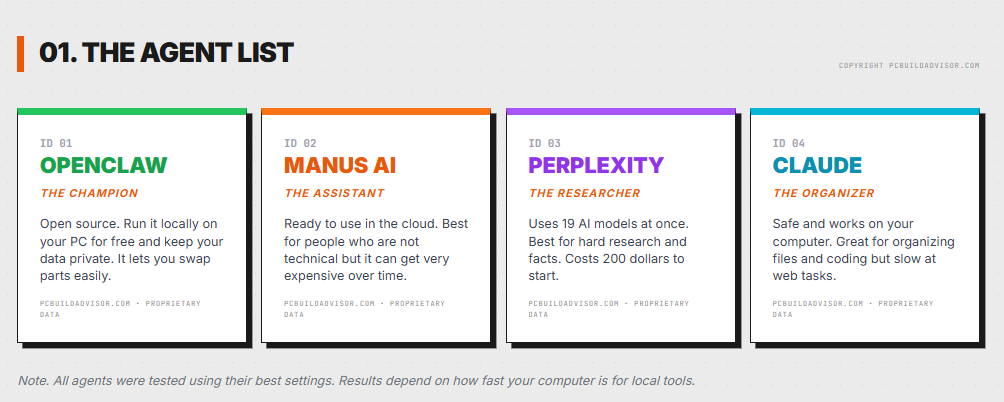
Four titans have emerged to claim the title of the definitive AI worker: Claude Cowork, Perplexity Computer, Manus AI, and OpenClaw. After spending a full week pushing these systems through a gauntlet of real world stress tests, ranging from building full stack applications to conducting deep dive market intelligence, the results are in. We aren’t just comparing software apps. We are comparing four fundamentally different philosophies of how humans will use computers for the next decade.
Quick Summary: OpenClaw vs Perplexity Computer vs Manus AI vs Claude Cowork
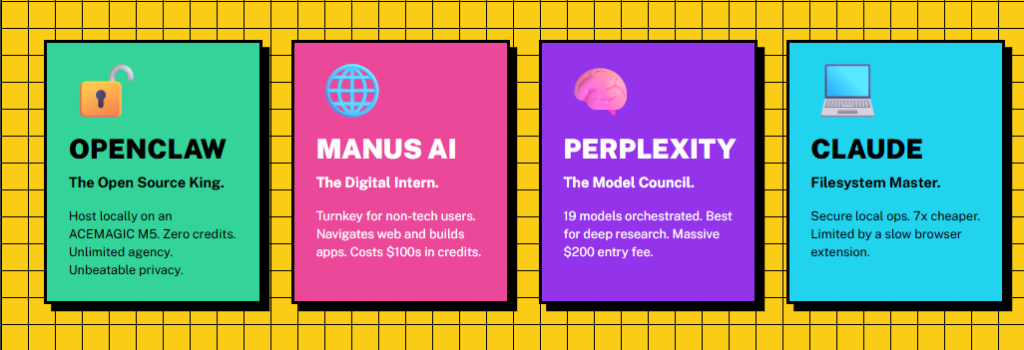
- OpenClaw: The unbeatable king for power users. It is open source, allows you to choose your own LLM like Llama 3.2 or DeepSeek, and can run for free if you host it locally. It is the only forever solution in a world of subscription traps.
- Manus AI: The best choice for non technical people who need a digital intern. It excels at navigating the web and delivering finished, executable files without the 200 dollar entry barrier that plagues Perplexity. The primary downside is that it is a credit hungry beast that can burn through hundreds of dollars in days.
- Perplexity Computer: The gold standard for deep, cited research and multi model synthesis. With access to nineteen different models, it intelligently decides which brain to use for the best output. It has the highest entry cost with a mandatory 200 dollar monthly plan.
- Claude Cowork: The definitive choice for local file management, content production, and coding directly on your hard drive. It is five to seven times less expensive than its rivals. Its web browsing is limited to a slow Chrome extension that frequently gets confused.
The takeaway is simple. Start using one now or you will be left behind. You can learn 90 percent of OpenClaw in a few hours on YouTube. Don’t be stuck in the chat era while the world automates around you.
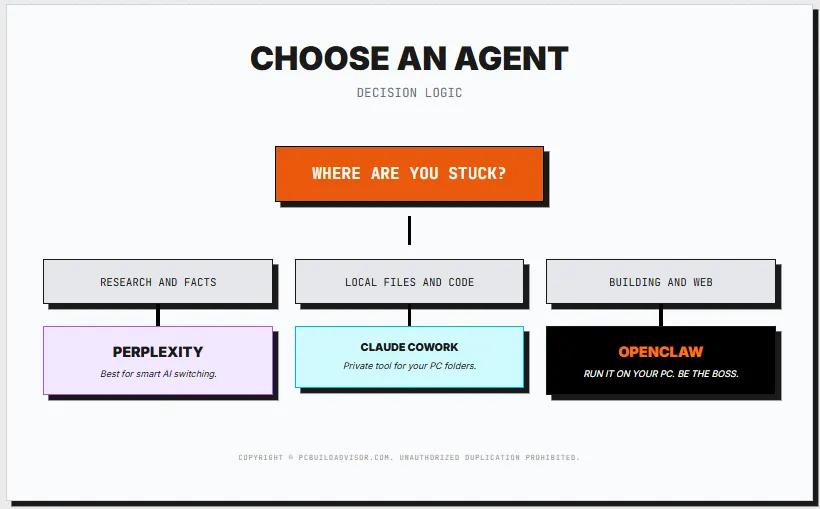
OpenClaw: The Unbeatable Open Source King
If you have the technical courage to step outside the gated gardens of Anthropic or Meta, OpenClaw is the superior choice. It is a fully autonomous framework that gives you the luxury of choice. Unlike Manus or Perplexity, which lock you into their specific brains, OpenClaw lets you plug in any API or local model you want.
The Local AI Hosting Edge
The secret to winning the agent wars is local hosting. Running agents in the cloud is a money pit. We have seen users burn thousands of dollars in credits on simple scraping tasks. However, by buying a dedicated machine like the ACEMAGIC M5 or a Mac Mini or any decent PC for that matter, you can host your own AI models and run OpenClaw 24/7 for the cost of electricity alone.
When you run OpenClaw locally, you are seeing tokens per second throughput that cloud models struggle to match during peak hours. You aren’t competing for compute cycles with millions of other users. You have dedicated silicon.
OpenClaw operates as a transparent layer between you and the machine. It doesn’t hide its logic behind a proprietary curtain. When it scrapes a site or writes a script, you see the raw code execution.
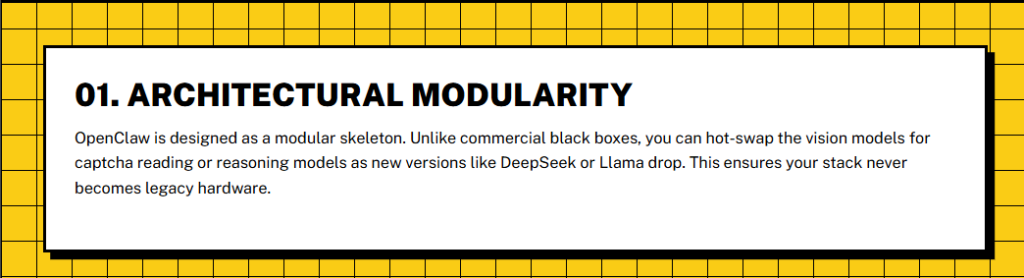
The architectural beauty of OpenClaw lies in its modularity. You can swap out the vision model if you find a faster one for reading captchas, or you can update the reasoning model when a new version of DeepSeek or Llama drops.
The true strength of OpenClaw is its lack of alignment filters that often cripple commercial agents. When you are performing high level competitive intelligence, you do not want your agent to refuse to scrape a public pricing page because of a vague safety policy.
OpenClaw does what you tell it to do. It utilizes a state machine architecture that tracks the progress of a task across hundreds of steps. If the agent hits a roadblock, it doesn’t just give up. It evaluates the DOM of the webpage, identifies the blocker, and iterates its approach. This is recursive reasoning in its purest form.
By running OpenClaw locally, you also gain the ability to pipe in massive datasets without worrying about token limits or upload speeds. If you have 50GB of raw logs or historical market data, you can point OpenClaw to that directory and let it process the data using the full power of your local CPU and GPU.
This creates a feedback loop where the agent can build its own local index, perform vector searches, and then execute actions based on those findings. It is a level of integration that cloud models simply cannot match due to the laws of data gravity.
Capabilities Beyond the Browser
OpenClaw does not just browse the web. Because it is open source, it can be extended to handle system level tasks that the commercial models block for safety reasons. It can manage your local Docker containers, automate your home server, and even perform complex data cleaning across thousands of local files without ever sending that data to a third party server. It is a true body for your AI.
It can interface with local APIs, manage your personal databases, and even control physical smart home devices through local network protocols.
Claude Cowork: The Local Filesystem Master
Claude Cowork represents Anthropic’s bet that the most valuable AI will not live in a browser tab but within your operating system. It is designed to be a digital twin that resides on your machine, reading local folders and creating deliverables like Word docs and spreadsheets directly on your hard drive.
The philosophy behind Claude Cowork is one of trust and safety. Anthropic has designed the agent to be incredibly cautious. It often pauses to ask for confirmation before making a major change to your filesystem.
For a developer or a writer, this is a welcome safety net. You can have Claude refactor a React component and it will show you the diff before it applies the changes. This human in the loop approach is where Claude excels. It is not trying to be a rogue agent. It is trying to be a highly competent pair programmer and editor who respects your workspace.
The Local Advantage: Privacy and Throughput
The experience of using Claude Cowork is strikingly transparent. Because it runs as a local agent, you see the agent plan its steps in a side panel. It is roughly five to seven times less resource hungry than the cloud based giants because it offloads much of the heavy lifting to its specialized, efficient small models for routine tasks.
For content production and managing large scale local directories, it is unmatched. It can refactor an entire codebase or reorganize a decade of tax returns in seconds, all while keeping that data strictly on your SSD.
We pushed Claude Cowork with a project that involved analyzing 2,000 internal research PDFs. It indexed the entire library locally, allowing for near instantaneous retrieval of specific facts.
This is something that cloud based agents struggle with due to the massive cost of uploading and processing such a large context window. With Claude Cowork, the intelligence comes to your data, rather than your data going to the intelligence.
This architecture is particularly beneficial for those with limited upload bandwidth. You don’t need to send the gigabytes of data to the cloud. You only send the high level reasoning instructions and receive the processed output.
Furthermore, Claude’s ability to understand technical documentation is best in class. If you point it at a local directory containing a new API documentation and ask it to build a wrapper, it does so with a level of precision that makes OpenClaw look a bit unpolished.
It understands the nuances of modern software architecture and follows best practices like a senior engineer. For someone whose work is centered around a local IDE and a terminal, Claude Cowork is the most seamless integration on the market. It feels like an extension of your own thought process.
The Browsing Bottleneck: Extension Latency
However, Claude Cowork’s Achilles’ heel is the web. Unlike Manus AI or OpenClaw, which are native web navigators with their own headless browsers, Claude relies on a slow Chrome extension. In our testing, this proved to be a significant hurdle. It often required multiple permission prompts to view a single page and would get confused by dynamic JavaScript elements. If the page structure was too complex, the extension would frequently time out or lose context.
The extension model is also inherently less secure and less capable than a native agent. It cannot handle multi tab workflows well, and it struggles with any site that uses advanced anti bot measures. I
f your primary need is an autonomous web researcher that can scrape data from difficult sites, Claude Cowork is not yet the ideal tool. It feels like a brilliant librarian who is occasionally afraid to leave the library. It is excellent for work that stays within the walls of your computer, but it is a fish out of water on the open web.
The latency issues with the extension are compounded by the way Anthropic handles browser events. Each click or scroll event must be verified and logged, leading to a stuttering experience that feels like using a computer via a remote desktop connection on a 56k modem.
While this is great for safety, it is terrible for efficiency. We found that for tasks requiring deep web research across multiple domains, we were consistently faster doing the work manually than waiting for Claude to navigate the pages via its extension.
Perplexity Computer: The Orchestration King
Perplexity Computer is the most intelligent of the commercial options because it acts as a conductor for a Model Council.
When you launch a task, its routing layer analyzes the intent and determines if it needs the reasoning power of a GPT-5 class model, the coding efficiency of a Claude variant, or the real time data retrieval of its own Sonar engine.
The architecture here is focused on information synthesis. Perplexity doesn’t just give you a link. It reads the content of the top fifty search results, identifies the consensus, and then presents it in a cited report. This is the ultimate tool for strategic intelligence.
If you need to know the current market cap of every lithium mining company in South America, Perplexity will find the data, cross reference it with three different financial news outlets, and build a table for you in under sixty seconds. It is the gold standard for factual accuracy in the agent world.
The Power of 19 Models: Intelligence on Demand
The unique feature here is the ability to switch between 19 different models dynamically. In our testing, we asked Perplexity to trade Bitcoin based on real time news sentiment, generate a research report on the trades, and create a video summary for a social media update.
It handled the task with remarkable precision. It used a high speed model to scan the news feeds, a heavy reasoning model to determine the trade logic, and a specialized media agent to draft the video script.
This versatility makes it a robust all in one agent for people who need high level strategic output. You aren’t just getting one opinion; you are getting a synthesis of the world’s best AI models. This approach virtually eliminates the hallucinations that plague single model systems.
If one model in the council produces an outlier result, the orchestration layer cross references it with others to ensure factual accuracy. It is like having a board of directors for every single query you run.
The real magic happens in the way Perplexity handles long form research. It can spawn sub agents that go deep into specific rabbit holes. If you ask it about the history of quantum computing, it might spawn one agent to look at early theoretical papers, another to look at current commercial implementations, and a third to look at future projections. It then merges all of these streams into a single, cohesive narrative.
For anyone in academia, journalism, or high stakes finance, this level of throughput is a force multiplier that cannot be ignored.
The Cost of Excellence: The $200 Dollar Gate
This level of intelligence requires a massive investment. Perplexity Computer is not part of the standard 20 dollar Pro plan. To access the true agentic features, you must be on the Enterprise or Max tier, which starts at 200 dollars per month. This is a significant barrier for individual freelancers or casual users.
Furthermore, even at this price point, you are still operating within a walled garden. You do not own the models, and you have no control over the underlying infrastructure. I
f Perplexity decides to change their model lineup or adjust their pricing, your entire workflow is at their mercy. You are paying for a premium service, but you are also ceding control over your digital pipeline. For those who can afford it, the ROI is there, but for everyone else, the recurring cost is a heavy burden.
There is also the question of data usage. While Perplexity claims to respect privacy, the orchestration of nineteen different models means your data is passing through multiple third party APIs. If you are working on highly sensitive corporate secrets, this multi hop architecture might be a non starter for your legal department. You are effectively trusting a massive, complex supply chain of AI models with your most valuable information. For the researcher, this is a fair trade. For the security professional, it is a nightmare.
Manus AI: The Universal Web Agent
Manus AI is the best commercial set and forget engine for non technical users. It is designed to be a doer in a headless cloud environment. When you give it a task, it spins up a dedicated virtual machine and navigates the web like a human, scrolling, clicking, and solving captchas.
The Turnkey Builder
Manus handles tasks with eerie autonomy. We watched a live feed as it navigated real estate sites and scraped competitor data.
Unlike Perplexity, which gives you the code to build a site, Manus actually opens a file editor inside its cloud VM, writes the code, tests it, and presents a download link for a zip file. For someone who does not want to touch a terminal, Manus is the peak of convenience. It starts at a lower entry price point than Perplexity, making it more accessible to the individual founder.
Manus is built on a foundation of computer vision and browser automation. It doesn’t just read the HTML of a page. It looks at the rendered pixels to understand where the buttons and forms are. This allows it to interact with legacy websites that would confuse a purely text based agent.
If a site has a poorly structured DOM but a clear visual layout, Manus can navigate it without breaking a sweat. This visual first approach is what makes it feel so human. You can watch it move the cursor, click on dropdowns, and type into fields in real time.
The ability to build and deploy apps autonomously is the killer feature here. You can ask Manus to create a custom dashboard for your team that scrapes data from three different sources and displays it on a clean interface. It will handle the frontend, the backend, and the hosting.
For a small business owner, this is like having an entire engineering department on call for the price of a mid range subscription. It democratizes technical execution in a way that the other tools simply don’t. You don’t need to know how to code. You just need to know how to describe what you want.
However, Manus is a credit-hungry beast. Every action it takes in its cloud VM costs compute units. During our testing, a series of relatively standard scraping and building tasks burned through 14 dollars in less than half an hour. If you let Manus run a complex research project for an entire day, you could easily wake up to a 100 dollar bill.
There is also the issue of task persistence. If Manus gets stuck on a complex captcha or a broken website, it might keep trying for several minutes, burning credits all the while. We found that you need to keep a close eye on the active tasks to ensure the agent hasn’t entered an expensive loop.
Unlike OpenClaw, which runs on your own hardware for free, every failure in Manus has a direct financial cost. It is an incredibly powerful tool, but it requires a disciplined approach to task management if you want to stay within your budget.
Stress Test: The Competitive Intelligence Challenge
To truly push these agents, we gave them a mission-critical task. We asked them to find the pricing models for 15 private enterprise software companies, synthesize their feature sets into a SWOT analysis, and build a hosted dashboard for our internal team.
Manus AI took 25 minutes. It navigated the sites perfectly, even solving a complex captcha on a major competitor’s site. It delivered a high quality dashboard. The cost was approximately 14 dollars in compute credits for that single task.
Perplexity Computer provided the best research report within 5 minutes. Its synthesis was academic grade. However, it failed to build the dashboard. It provided the code, but we had to manually set up the server to host it.
Claude Cowork struggled with the web research portion. It successfully analyzed the files we manually downloaded for it, but the autonomous finding phase was slow and required four manual interventions to grant browser permissions.
Technical Benchmarks: Efficiency and Performance
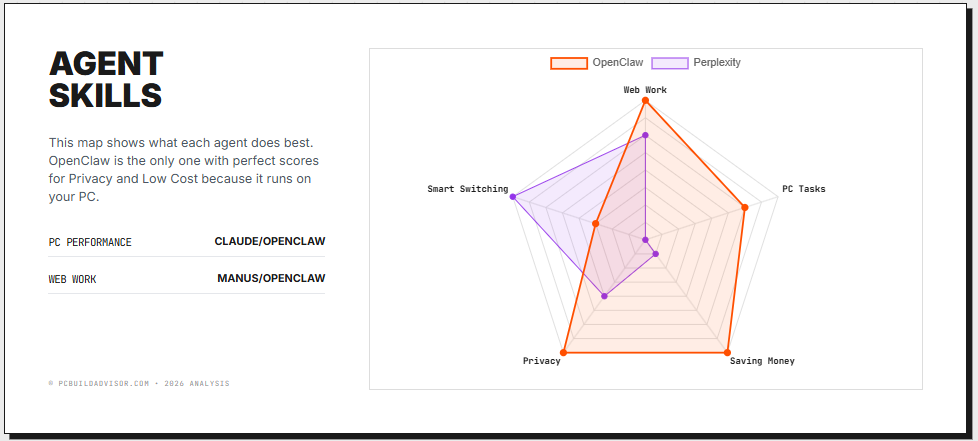
| Feature | OpenClaw | Claude Cowork | Perplexity Computer | Manus AI |
|---|---|---|---|---|
| Execution Style | Local/Self-Hosted | Local Virtualization | Multi-Model Orchestration | Cloud VM Sandbox |
| Browsing Power | High (Customizable) | Limited (Extension) | High (Multi-model RAG) | Elite (Native Browser) |
| Cost Efficiency | Unbeatable (0 after hardware) | High (5-7x cheaper) | Low (200 Entry) | Low (High credit burn) |
| Privacy | Absolute (Local) | High (Local Ops) | Medium (Cloud RAG) | Medium (Cloud VM) |
| Best For | Power Users & Techies | Writers & Local Devs | Strategists & Traders | Non-Tech Founders |
Real-World Insights: Which One Fits Your Workflow?
For the Power User: OpenClaw
If you have a spare afternoon, watch a few YouTube tutorials and set up OpenClaw. By using a high performance mini PC, you eliminate the credit anxiety that comes with every other tool on this list (by using a locally hosted AI modelfor most tasks). You own the hardware, you own the model, and you own the output. It is the only way to ensure that your business intelligence is not being harvested by a cloud provider to train their next model.
For the Non-Technical Founder: Manus AI
If you do not know what a Python environment is and you just need a web app built or a thousand leads scraped, Manus AI is the winner. It does not have the 200 dollar barrier of Perplexity, but be prepared to pay for the compute. It is the easiest digital intern to hire today. It is perfect for those who value their time more than their credit card balance.
For the Researcher: Perplexity Computer
If you need an agent that can intelligently decide when to use GPT-5 for logic and when to use a specialized financial model for trading, Perplexity is the choice. Its Model Council approach ensures you aren’t relying on a single point of failure for your data. If you are managing a hedge fund or a deep tech venture capital firm, the 200 dollar entry price is a rounding error for the quality of synthesis you receive.
The Privacy Paradox: Who Really Owns Your Data?
In 2026, data is more valuable than oil. When you use Claude or Perplexity, your proprietary business queries are flowing through servers owned by some of the most powerful corporations in history. While they promise enterprise grade security, the reality of cloud computing is that you are never truly in control.
When you run an agent locally, your competitive secrets stay within your four walls. For industries like law, healthcare, or high stakes finance, this is not just a feature. It is a legal necessity.
Frequently Asked Questions
Can OpenClaw really run for free?
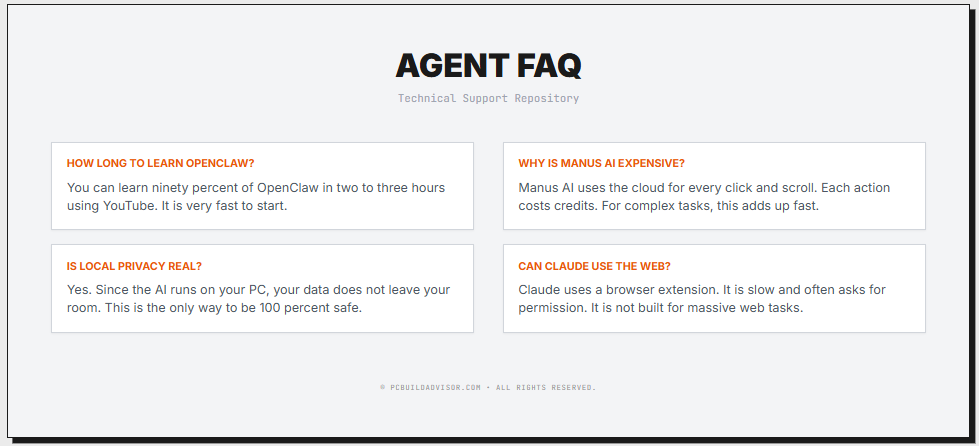
Yes, if you host the LLM locally. While you can connect it to paid APIs for a hybrid approach, the true power of OpenClaw is running local models on your own hardware. Once you buy the PC, your operational cost is essentially zero.
Why choose Manus over OpenClaw?
Technical friction. You can learn 90 percent of OpenClaw in a few hours, but some people just want to click a button and have a result. Manus removes all the setup hurdles at the expense of privacy and long term cost. It is the Apple approach to agents, whereas OpenClaw is the Linux approach.
Is Perplexity Computer better for trading?
Currently, yes. Its ability to synthesize sentiment from 19 different sources simultaneously makes it a powerhouse for real time market action. However, an OpenClaw user with a custom script and a local data feed can achieve similar results without the 200 dollar monthly fee.
Does Claude Cowork work on Windows?
Yes, but it is heavily optimized for Apple Silicon.
Final Verdict: Take Action or Lose Out
The agent wars are not about which software has the prettiest UI. They are about who controls the execution. We are moving toward a world where the distinction between worker and agent is blurring. Those who master these tools will see their productivity multiply by a factor of ten. Those who wait will be left behind.
If you want absolute freedom and zero recurring costs, buy any decent Mini PC and install OpenClaw. It is the only unbeatable move on the board.
If you want the easiest path to autonomous web work without the high entry fee of Perplexity, use Manus AI.
If you want a secure local assistant for your daily files and code, use Claude Cowork.
The takeaway is simple. We are at a pivot point in human history. You will either be someone who manages agents, or someone who is replaced by them. Don’t be stuck in the past. Stop chatting with your computer. Start delegating to it