As of April 4, 2026, you can no longer use your Claude Pro or Max subscription credits with OpenClaw or any other third-party AI tool. Anthropic officially blocked this. You can still use Claude with OpenClaw, but you will need to pay separately via a pay-as-you-go API key or an “Extra Usage” bundle. And no, simply using OpenClaw does not get you banned, but there are some important nuances you need to understand before moving forward.
If you have been using OpenClaw powered by your Claude subscription and suddenly hit a wall, you are not alone. This change blindsided thousands of users and sparked a massive debate in the AI community. Let me break down exactly what happened, what your options are now, and whether you are at any risk of getting your account suspended.
What Is OpenClaw and Why Did This Happen?
OpenClaw is a free, open-source AI agent framework that launched in late 2025 under its original name “Clawdbot.” It quickly became one of the most popular tools for developers who wanted to automate complex tasks using large language models like Claude, ChatGPT, Grok, and Google Gemini. The appeal was obvious: you could wire up a powerful agentic workflow and run it all through your flat-rate Claude subscription instead of paying per token through the API. For heavy users, that was a massive cost advantage.
The problem, from Anthropic’s perspective, was that this was never how the subscription was designed to work. Agentic tools like OpenClaw run continuous reasoning loops, retry tasks automatically, and chain together multiple tool calls in a single session. That kind of usage is far more compute-intensive than a typical user having a conversation on Claude.ai. The Verge’s April 2026 report on the OpenClaw policy change confirmed that Anthropic’s Head of Claude Code, Boris Cherny, stated directly that “subscriptions weren’t built for the usage patterns of these third-party tools.”
Essentially, a small number of power users running OpenClaw through subscriptions were consuming a disproportionate amount of Anthropic’s compute resources, and the flat-rate subscription model was never priced to account for that.
The Timeline: How the Ban Unfolded
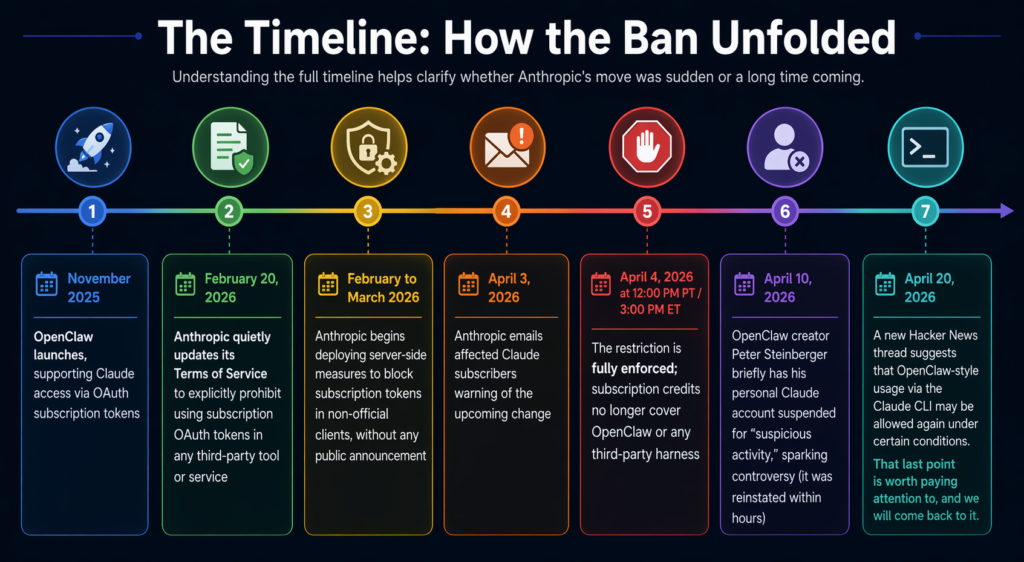
Understanding the full timeline helps clarify whether Anthropic’s move was sudden or a long time coming.
-
November 2025: OpenClaw launches, supporting Claude access via OAuth subscription tokens
-
February 20, 2026: Anthropic quietly updates its Terms of Service to explicitly prohibit using subscription OAuth tokens in any third-party tool or service
-
February to March 2026: Anthropic begins deploying server-side measures to block subscription tokens in non-official clients, without any public announcement
-
April 3, 2026: Anthropic emails affected Claude subscribers warning of the upcoming change
-
April 4, 2026 at 12:00 PM PT / 3:00 PM ET: The restriction is fully enforced; subscription credits no longer cover OpenClaw or any third-party harness
-
April 10, 2026: OpenClaw creator Peter Steinberger briefly has his personal Claude account suspended for “suspicious activity,” sparking controversy (it was reinstated within hours)
-
April 20, 2026: A new Hacker News thread suggests that OpenClaw-style usage via the Claude CLI may be allowed again under certain conditions
That last point is worth paying attention to, and we will come back to it.
Will Anthropic Ban You for Using OpenClaw?
This is the question most users are understandably worried about, and the answer is nuanced but mostly reassuring.
Anthropic has not issued blanket bans for OpenClaw users. The restriction is specifically about using your subscription quota to cover that usage. You are expected to either use an API key with pay-as-you-go billing, or purchase an “Extra Usage” bundle.
When OpenClaw’s own creator, Peter Steinberger, had his account temporarily suspended on April 10, 2026, it sparked immediate panic in the community. TechCrunch’s coverage of the Steinberger suspension confirmed that Anthropic clarified they had never banned anyone specifically for using OpenClaw, and an Anthropic engineer personally reached out to help restore Steinberger’s account. The suspension appeared to be triggered by automated “suspicious activity” detection, not a deliberate targeting of OpenClaw users.
The bottom line on bans: You are not going to get banned simply for using OpenClaw with Claude. But if you try to continue routing OpenClaw usage through your subscription OAuth token after the April 4 restriction, you are violating Anthropic’s Terms of Service. That could, in theory, put your account at risk over time.
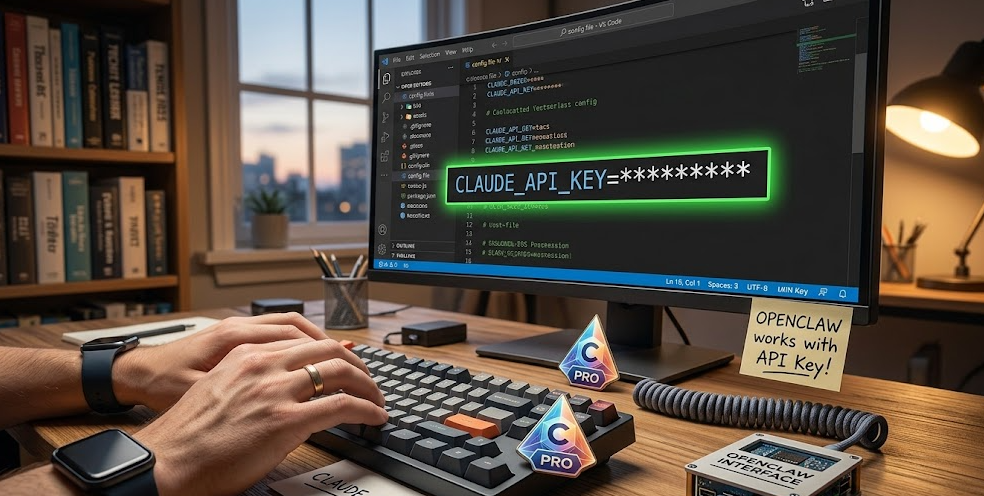
Pro Tip: If you want to keep using Claude as your primary model in OpenClaw, the cleanest path is to set up a Claude API key directly inside OpenClaw’s settings. This keeps you fully compliant with Anthropic’s policies and gives you transparent, predictable billing based on actual usage rather than a flat subscription that no longer covers your workflow.
Your Options: How to Use Claude with OpenClaw in 2026
Now that the subscription route is off the table, here is what you can actually do.
Option 1: Claude API Key (Pay-As-You-Go)
The most straightforward and fully supported path. You generate a Claude API key from console.anthropic.com and plug it directly into OpenClaw. You pay per token consumed. This is what Anthropic recommends and it is the most future-proof option.
Option 2: Claude Extra Usage Bundles
Anthropic introduced a new “Extra Usage” billing layer specifically for situations like this. You can still log in with your Claude account inside OpenClaw, but any usage beyond the standard subscription will be billed separately at pay-as-you-go rates. Anthropic even offered a limited-time 30% discount on Extra Usage bundles as a transition offer for affected subscribers (note: this was available through mid-April 2026).
Option 3: Switch to a Different LLM
OpenClaw was built to be model-agnostic. If Claude costs are a concern, you can swap to GPT-4o, Gemini, Grok, or even local models via Ollama. Based on my experience testing these combinations, Claude still edges out most competitors for complex reasoning and code-generation tasks inside agentic workflows, but the cost difference with API billing can be significant depending on usage volume.
Option 4: Use Anthropic’s First-Party Tools
Anthropic’s own Cowork agent, Claude Code CLI, and the Claude desktop app are all fully exempt from these restrictions and continue to have generous subscription limits. If your workflow can be replicated inside Claude’s native tools, that is worth exploring.
Claude Pricing for OpenClaw: What Will You Actually Pay?
Here is a breakdown of the key models and their API costs if you switch to the pay-as-you-go route for OpenClaw.
For most OpenClaw power users doing daily development work, Claude Sonnet strikes the best balance of capability and cost. Opus is excellent for complex tasks but can get expensive fast if your agents run long sessions.
The Bigger Picture: What This Means for Open-Source AI Tools
Anthropic’s move against OpenClaw is not just a billing change. It is a signal about where the AI industry is heading in 2026, and it has real implications for the open-source AI ecosystem.
When OpenClaw launched, it represented something genuinely exciting: a model-agnostic, open-source agent framework that let users mix and match the best AI tools without being locked into any single provider’s ecosystem. That is exactly why it grew so fast. And it is also, arguably, exactly why providers like Anthropic eventually had to put guardrails around it.
There is also a competitive angle that is hard to ignore. As This in-depth analysis on Mission Cloud’s blog points out, Anthropic launched its own Cowork agent and the Claude Dispatch feature just weeks before restricting OpenClaw. OpenClaw’s creator Peter Steinberger was publicly critical of the timing, posting that “first they copy popular features into their closed harness, then they lock out open source.” Whether that is a fair characterization or not, the optics were not great for Anthropic.
The April 20, 2026 Hacker News thread suggesting that OpenClaw-style usage via the Claude CLI may be permitted again is an interesting development. At the time of writing, Anthropic has not issued an official statement confirming this, so treat that with appropriate caution until there is clarity.
Step-by-Step: Setting Up Claude API Key in OpenClaw
If you are ready to switch to the API key method, here is exactly how to do it.
-
Go to Console.anthropic.com and log in with your Anthropic account
-
Navigate to API Keys in the sidebar and click Create Key
-
Copy your API key and store it somewhere secure (you will not be able to view it again)
-
Open OpenClaw and go to Settings > Model Providers
-
Select Anthropic / Claude as your provider
-
Paste your API key into the API Key field
-
Select your preferred Claude model (Sonnet for balance, Haiku for speed and cost savings, Opus for heavy tasks)
-
Save your settings and test with a simple task to confirm everything is connected
This setup takes about five minutes and fully complies with Anthropic’s current policy. You will get per-token billing through your Anthropic account, with full transparency into your usage via the console dashboard.
Frequently Asked Questions
Can I still use OpenClaw with Claude in 2026?
Yes, you can still use OpenClaw with Claude. The only thing that changed is that your Claude Pro or Max subscription credits no longer cover that usage. You need to use a Claude API key or an Extra Usage bundle to pay for the tokens consumed through OpenClaw.
Will Anthropic ban my account if I use OpenClaw?
Using OpenClaw itself does not trigger a ban. However, using your subscription OAuth token to route OpenClaw usage violates Anthropic’s updated Terms of Service and could flag your account. Stick to the API key method to stay fully compliant.
What happened to OpenClaw’s creator and Anthropic?
OpenClaw was created by Peter Steinberger, who joined OpenAI in early 2026. On April 10, 2026, his personal Claude account was briefly suspended for “suspicious activity” while he was testing OpenClaw compatibility. The account was reinstated within hours and Anthropic confirmed they had never banned anyone specifically for using OpenClaw.
Is the Claude API more expensive than the subscription for OpenClaw use?
It depends entirely on how much you use it. For light to moderate use, the API can actually end up being comparable or cheaper. For very heavy, continuous agentic workflows, costs can climb significantly. The key is monitoring your token consumption in the Anthropic console.
Does this ban affect other third-party tools besides OpenClaw?
Yes. Anthropic stated clearly that the policy “applies to all third-party harnesses” and that it would be rolled out more broadly beyond OpenClaw. Any tool that routes usage through your subscription OAuth token is affected.
What are the best alternatives to Claude for OpenClaw?
If API costs with Claude are too high, GPT-4o is a solid alternative with competitive pricing. For budget-conscious users, GPT-4o-mini or local models via Ollama are compelling options. That said, Claude remains a top choice for reasoning-heavy agentic workflows, so many users find the API cost worth it.
Did Anthropic offer any compensation for the change?
Yes. Anthropic offered affected subscribers a one-time credit equivalent to one month’s subscription fee, plus discounted Extra Usage bundles at up to 30% off as a limited transition offer. That window has now closed for most users, but it is worth checking your account if you were notified in early April.
What’s Coming Next: 2026 Trends for OpenClaw and Claude
The OpenClaw situation is a preview of a broader pattern shaping AI in 2026. Major AI companies are tightening the boundaries between their subscription products and third-party ecosystems. We are seeing a “platform wars” dynamic play out, where providers want users inside their own native tooling rather than powering third-party tools at flat-rate prices.
For developers and power users, this means the era of getting unlimited agentic compute through a $20/month subscription is effectively over. Going forward, serious use of AI agents like OpenClaw will require either API-based billing with careful token management or enterprise-tier agreements. The good news is that model pricing has continued to fall through 2026, which partially offsets the shift from subscription to pay-as-you-go.
The one development worth watching is whether Anthropic reverses course on CLI-based OpenClaw usage, as the recent Hacker News thread suggested. If an official policy clarification comes, it could reopen a more affordable path for developers who want to use Claude with OpenClaw without a full API setup. For now, though, the API key route is your safest and most reliable option.
Check out This YouTube breakdown of the OpenClaw ban and what it means for developers for a solid visual walkthrough of the situation if you prefer video format.
You can absolutely keep using OpenClaw with Claude, just not for free through your subscription anymore. Set up a Claude API key, monitor your usage, and you will be good to go with zero risk to your account. The change is frustrating, but the path forward is clear.