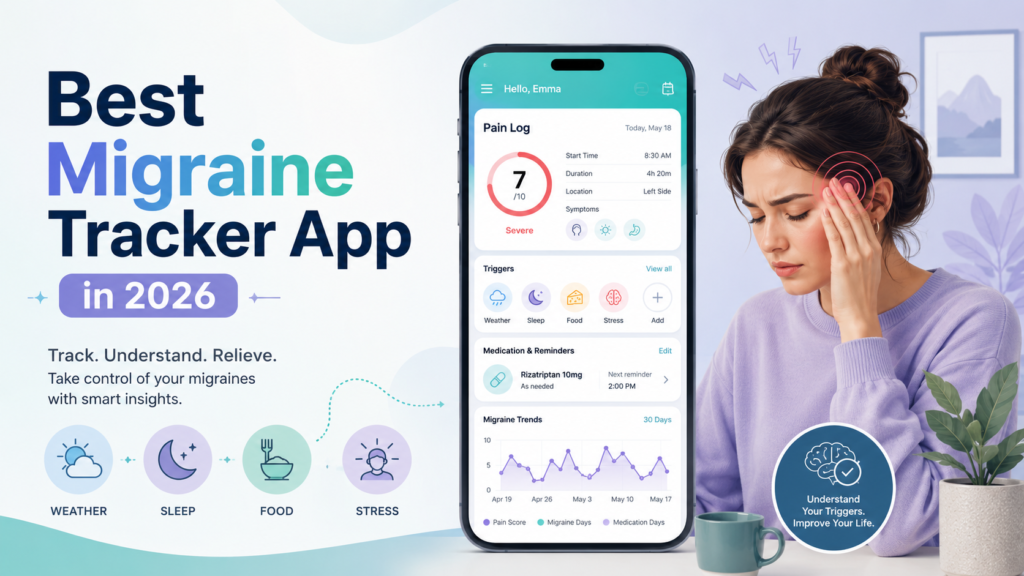
The best migraine tracker app in 2026 is Claru for AI-powered prediction, and Migraine Buddy for the most well-rounded, community-backed experience. But the right app really depends on what you need most, whether that is doctor-ready reports, trigger analysis, or simple daily logging. Read on to find the best fit for you.
Migraines are not just bad headaches. They are debilitating neurological events that can knock you off your feet for hours, or even days. If you deal with them regularly, you already know that identifying your triggers is half the battle. That is exactly where a good migraine tracker app becomes a game changer.
The right app does not just log your headaches. It helps you spot patterns, understand your triggers, communicate more effectively with your doctor, and in some newer cases, even predict when a migraine might be coming. In 2026, the options have gotten significantly better, with AI integration, weather correlation tools, and much cleaner user interfaces across the board.
I have spent a good amount of time testing and reviewing health tracking apps, and the migraine app space in particular has evolved a lot over the last couple of years. This guide breaks down the 10 best migraine tracker apps available right now on iOS and Android, with a full comparison table, FAQs, and everything you need to make the right choice.
Why Tracking Your Migraines Actually Matters
Before we get into the apps, it is worth understanding why tracking is so important. Most neurologists and headache specialists will tell you that one of the first things they ask patients to do is keep a headache diary. The reason is simple: migraines are highly personal. Your triggers are not the same as someone else’s.
Tracking helps you identify patterns that are otherwise impossible to see in the moment. Things like sleep disruption, barometric pressure changes, hormonal cycles, hydration levels, caffeine intake, and stress all contribute in ways that are hard to connect without data. When you bring three months of consistent tracking data to your doctor, you give them a much clearer picture to work with.
The American Migraine Foundation’s resource library on headache journals highlights that consistent tracking leads to better conversations with your healthcare provider and more targeted treatment decisions. That is really the core value of these apps.
What to Look for in a Migraine Tracker App
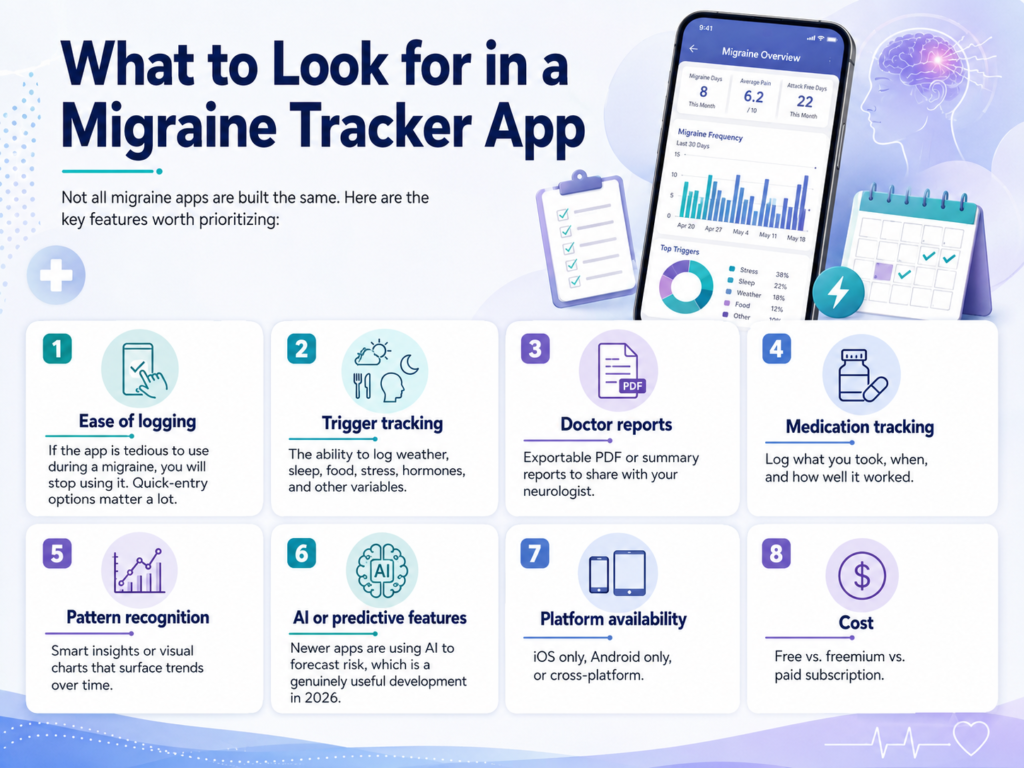
Not all migraine apps are built the same. Here are the key features worth prioritizing:
-
Ease of logging: If the app is tedious to use during a migraine, you will stop using it. Quick-entry options matter a lot.
-
Trigger tracking: The ability to log weather, sleep, food, stress, hormones, and other variables.
-
Doctor reports: Exportable PDF or summary reports to share with your neurologist.
-
Medication tracking: Log what you took, when, and how well it worked.
-
Pattern recognition: Smart insights or visual charts that surface trends over time.
-
AI or predictive features: Newer apps are using AI to forecast risk, which is a genuinely useful development in 2026.
-
Platform availability: iOS only, Android only, or cross-platform.
-
Cost: Free vs. freemium vs. paid subscription.
The 10 Best Migraine Tracker Apps in 2026
1. Claru (iOS and Android) – Best Overall for AI Prediction
Claru is the newest standout in the migraine app space and has quickly earned its spot at the top of several 2026 rankings. What sets it apart is its AI engine, which combines your personal migraine history with real-time weather data, sleep patterns, and stress levels to generate a daily migraine risk score. It is essentially telling you, “hey, your risk is elevated today,” before the headache even starts.
The voice logging feature is particularly useful when you are mid-migraine and the last thing you want to do is tap through menus. You just speak and the app captures the details. User reviews consistently highlight how this feature alone makes Claru worth using.
Claru is available free with in-app purchases on both the App Store and Google Play. It is one of those apps that feels genuinely designed for migraine sufferers rather than adapted from a general health tracker.
Best for: People who want AI-powered predictions and a modern, intuitive experience.
2. Migraine Buddy (iOS and Android) – Best All-Around App
Migraine Buddy is the most widely used migraine tracking app in the world, with over 4.8 million users. It was developed with input from neurologists and data scientists, which shows in its depth of features. You can log pain location using a head map, track aura symptoms, record medications and their effectiveness, monitor sleep, and connect with a support community.
The monthly reports are detailed and doctor-friendly, which makes this one especially valuable if you have regular specialist appointments. The free version is generous, and the premium tier unlocks deeper analytics and insights.
In my experience reviewing health apps, Migraine Buddy strikes the best balance between comprehensive tracking and usability. It is not the flashiest app in 2026, but it is still the most trusted for good reason.
Best for: Anyone who wants a proven, feature-rich app with a large user community.
3. Migraine Insight (iOS and Android) – Best for Finding Triggers
Migraine Insight has been getting a lot of attention lately, and for good reason. The app focuses specifically on identifying what triggers your migraines using a science-backed approach. It tracks mood, sleep, activity, medications, and dozens of potential triggers, then surfaces correlations in easy-to-read visual reports.
According to the app’s own data, 85% of users reported reducing or eliminating migraines within 12 weeks of consistent use. The methodology behind it, which is rooted in identifying personal trigger patterns rather than generic advice, does hold up. Neurologists have cited it as one of the top apps they recommend to patients, which adds a layer of credibility that matters when you are dealing with a serious health condition.
Best for: People who are serious about identifying and eliminating their personal triggers.
4. N1-Headache by Curelator (iOS and Android) – Best for Clinical and Research-Grade Use
N1-Headache, developed by Curelator Inc., is one of the most scientifically sophisticated migraine tracking apps available. The “N1” in the name literally stands for the “n-of-1” trial methodology at the heart of the app, which treats your migraine history as a personalized clinical study. Rather than asking you to manually guess what causes your attacks, it uses statistical analysis on your logged data to identify confirmed triggers, confirmed protectors (factors that reduce your risk), and neutral variables that have no meaningful effect on your migraine patterns.
What makes N1-Headache especially powerful is its dual strength: it is both clinically oriented and scientifically rigorous. The app was designed with healthcare providers in mind, offering a web-based clinician dashboard that lets your neurologist or headache specialist monitor your outcomes and measure therapeutic response in real time. You log daily data for 90 days, and at the end you receive a Personal Analytical Report that your doctor can use to meaningfully guide your treatment plan.
It requires patience, since the analysis only becomes meaningful after that consistent 90-day period, but the payoff is a level of personalized insight that no other app on this list can match. It is one of the few migraine apps recommended by the National Headache Foundation.
Best for: Patients working closely with a neurologist who want both research-grade trigger analysis and real-time clinical integration.
5. Bearable (iOS and Android) – Best for Holistic Health Tracking
Bearable is not exclusively a migraine app. It is a comprehensive symptom and health tracker that happens to be excellent for migraine management. You can track symptoms, mood, sleep, energy, treatments, and medications, then visualize correlations between all of them over time.
The migraine-specific features include unlimited symptom logging, trigger tracking, and medication monitoring, all available in the free version. What makes Bearable unique is its broader health lens. If your migraines are connected to anxiety, sleep issues, or other chronic conditions, Bearable lets you track all of it in one place and see how everything intersects.
Bearable’s dedicated migraine tracker page explains how the correlation charts work and why this approach helps surface triggers that more narrowly focused apps might miss.
Best for: People managing migraines alongside other chronic health conditions.
6. Headache and Migraine Tracker by Sinoapps (iOS and Android) – Best No-Frills Free Diary
Headache and Migraine Tracker by Sinoapps is a clean, dedicated headache diary app that does exactly what it promises without unnecessary complexity. You can log headache severity, duration, symptoms, potential triggers, and medications in just a few taps. The interface is stripped back by design, which is genuinely useful when you are in the middle of an attack and cannot be bothered navigating a complex menu system.
There are no subscriptions, no premium upsells, and no social features. It is a straightforward digital diary built purely for the purpose of tracking headaches. For people who tried other apps and found them overwhelming or cluttered, this is a breath of fresh air.
Best for: Beginners or anyone who wants a simple, clean, completely free dedicated tracker.
7. Migraine Monitor (iOS and Android) – Best for Weather Correlation
Migraine Monitor is one of the few apps that factors local weather conditions directly into your migraine tracking, which is a significant differentiator because barometric pressure changes are a well-documented migraine trigger. The app tracks headache frequency, duration, and severity while simultaneously pulling in weather data for your location.
It also offers daily migraine-related tips and lets you share detailed reports with your doctor. The free version is fully functional, which makes it accessible without any financial commitment.
Best for: People whose migraines are heavily influenced by weather or barometric pressure changes.
8. Canadian Migraine Tracker (iOS and Android) – Best Free Doctor-Approved Option
The Canadian Migraine Tracker is a genuinely excellent free app that deserves far more attention than it typically gets outside of Canada. Developed in collaboration with neurologists and recommended by migraine specialists, it is available in both English and French on iOS and Android, and every single feature is completely free with no premium tier or in-app purchases.
The app is clean and focused. You log your migraine attacks, track triggers, record medications, and generate reports formatted specifically for neurologist appointments. What sets it apart is the credibility behind it: it was built with direct input from headache specialists and is actively recommended by the neurological community as a reliable clinical tool.
Best for: Anyone looking for a completely free, neurologist-recommended tracker with solid doctor reporting features.
9. Apple Health (iOS) – Best for iPhone Ecosystem Integration
Apple Health does not have dedicated migraine-specific features, but its integration capabilities make it a valuable tool for iPhone users. You can log headache symptoms directly, connect it with other health apps, and build a holistic picture of your health data including sleep, heart rate, activity, and menstrual cycle data, all of which can relate to migraines.
The value here is integration. If you are already deep in the Apple ecosystem and using an Apple Watch, Apple Health becomes a powerful central hub that connects all your health data points in one place.
Best for: iPhone users who want their migraine data integrated with their broader health picture.
10. Manage My Pain (iOS and Android) – Best for Chronic Pain Management
Manage My Pain is designed for people dealing with chronic pain conditions, and it handles migraine tracking as part of that broader framework. You can log pain levels, locations, related symptoms, and treatments. The app generates reports that are formatted specifically for healthcare appointments.
It is particularly well-suited for people who deal with migraines as part of a broader chronic pain experience, such as fibromyalgia or chronic back pain alongside recurring migraines.
Best for: Chronic pain patients who experience migraines as one of multiple pain conditions.
Pro Tip: Whatever app you choose, consistency is what makes the data useful. Even a basic log entry during an attack, just intensity, duration, and what you took, is more valuable than a detailed entry you only fill in occasionally. Set a daily reminder if needed. After 60 to 90 days of consistent tracking, patterns start to emerge that can genuinely change how your doctor manages your treatment.
Migraine Tracker App Comparison Table
Step-by-Step Guide to Effective Migraine Tracking
Step 1: Set up your profile completely
Most apps ask about your migraine history, medications, and common triggers during onboarding. Fill this out thoroughly. The more context the app has, the more useful its analysis will be from day one.
Step 2: Log every attack, even mild ones
It is tempting to only log the severe attacks, but mild headaches that share the same triggers are just as informative. Log all of them.
Step 3: Track potential triggers daily, not just during attacks
What you ate, how you slept, your stress level, your hydration, and even your screen time should ideally be logged every day. The relationship between triggers and attacks is rarely same-day, so you need data from the days before an attack too.
Step 4: Record medication timing and effectiveness
Note exactly when you took medication relative to the onset of the headache, and rate how well it worked. This helps your doctor assess whether your current treatment is actually effective.
Step 5: Generate and review reports monthly
Most apps offer monthly summary reports. Review them yourself before your doctor appointments. Look for patterns in the days of the week, times of the month, or environmental conditions that precede your attacks.
Step 6: Share reports with your healthcare provider
Bring printed or exported reports to your appointments. This is one of the most underutilized features of these apps. A well-organized tracking report can change your entire treatment plan.
2026 Trends in Migraine Tracking Technology
The migraine app space has evolved considerably heading into 2026. A few trends are worth knowing about:
AI-powered prediction is becoming standard. Claru led the charge, but other developers are integrating predictive risk scoring into their platforms. The idea of knowing your migraine risk before symptoms start is becoming less science fiction and more everyday reality.
Wearable integration is expanding. More apps are syncing with Apple Watch, Garmin, and Fitbit to pull in passive data like heart rate variability, sleep quality, and activity levels. This reduces the burden of manual logging and improves data accuracy.
Voice logging is growing. Typing during a migraine is painful, literally. Voice-based entry is becoming a key feature as developers recognize that accessibility during an attack is critical to consistent use.
Doctor connectivity features are improving. Apps are building better channels for sharing data directly with healthcare providers, not just exporting PDFs but enabling real-time or scheduled data sharing through integrated provider portals.
This YouTube overview of the best of headache medicine in 2025 gives a solid broader picture of where headache treatment and digital health tools are heading, straight from specialists in the field.
Frequently Asked Questions
What is the best free migraine tracker app in 2026?
The Canadian Migraine Tracker is completely free with no hidden tiers, and it is directly recommended by neurologists. Migraine Insight and Migraine Buddy also offer powerful free versions that outperform most paid competitors on features alone.
Are migraine tracker apps actually useful for doctor appointments?
Yes, genuinely. Most neurologists and headache specialists say that patients who bring tracking data to appointments get more productive consultations. Exportable reports from apps like Migraine Buddy and N1-Headache are specifically formatted to be useful in a clinical setting.
Which migraine tracker app is best for Android?
Migraine Buddy and Claru are both fully functional on Android with feature parity to their iOS versions. Migraine Insight and the Canadian Migraine Tracker are also strong on Android.
Can a migraine app predict when a migraine is coming?
Claru is the most advanced app for this right now, using your historical data combined with weather and lifestyle inputs to generate a daily risk score. It does not guarantee a prediction, but it gives you a heads-up that conditions are ripe for an attack.
How long should I track before seeing useful patterns?
Most specialists recommend tracking for at least 60 to 90 days to identify meaningful patterns. Some obvious triggers might become clear in a few weeks, but consistent logging over two to three months gives you much more reliable data. N1-Headache specifically requires 90 days before it generates its full analytical report.
Is Migraine Buddy still the best app in 2026?
Migraine Buddy is still excellent and remains the most widely used app. But Claru has emerged as a strong competitor, especially for users who want AI-powered features. The best app genuinely depends on what you need most.
Do migraine tracker apps replace seeing a doctor?
No. These apps are tools to support your healthcare, not replace it. They help you collect and organize information that makes your doctor visits more effective. Always consult a qualified healthcare provider for diagnosis and treatment decisions.
Are these apps safe to use with sensitive health data?
Reputable apps like Migraine Buddy, Claru, and Migraine Insight use encryption and follow standard data privacy practices. Always review the privacy policy of any health app before sharing personal medical data.
Bottom Line
The best migraine tracker app for you in 2026 comes down to one key question: what is your primary goal? If you want cutting-edge AI prediction, go with Claru. If you want the most trusted, feature-complete tracker with the largest user base, Migraine Buddy is still the gold standard. If trigger identification is your priority, Migraine Insight is hard to beat. And if you want something completely free and neurologist-approved, the Canadian Migraine Tracker punches well above its weight class.
Whatever you choose, the single most important factor is consistency. An app is only as good as the data you put into it. Start logging today, stick with it for 90 days, and you will likely learn more about your own migraines than you have in years. And as Migraine Buddy’s own research with its 4.8 million users consistently shows, that knowledge is genuinely empowering.