ZeroClaw and OpenClaw are both self-hosted, open-source autonomous AI agent frameworks, but they serve very different needs. OpenClaw is a feature-rich, ecosystem-heavy framework built for broad integration and enterprise-level orchestration, while ZeroClaw is an ultra-lightweight Rust-based runtime engineered for speed, security, and edge deployment. Choosing between the two really comes down to your hardware, your use case, and how much overhead you are willing to tolerate, and there are some important trade-offs worth understanding before you commit.
OpenClaw wins on features, community support, and messaging integrations. ZeroClaw wins on raw performance, security defaults, and resource efficiency. If you have constrained hardware or prioritize security, ZeroClaw is the better pick. If you need a rich plugin ecosystem and broad messaging support today, OpenClaw is the more mature choice.
What Is OpenClaw?
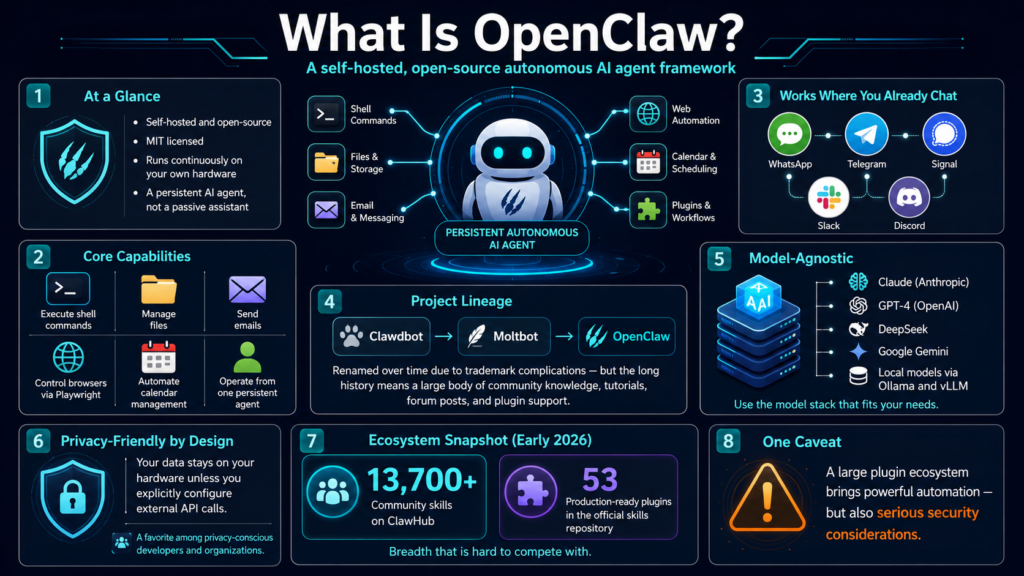
OpenClaw is a self-hosted, open-source autonomous AI agent framework licensed under MIT. Unlike traditional AI assistants that wait passively for your input, OpenClaw runs continuously on your own hardware and connects to the messaging apps you already use, including WhatsApp, Telegram, Signal, Slack, and Discord. It can execute shell commands, manage files, send emails, control browsers via Playwright, and automate calendar management, all from a single persistent agent.
The project has a bit of history worth knowing. It started life as Clawdbot, was renamed to Moltbot, and eventually became OpenClaw after trademark complications. That lineage actually matters because it means there is a substantial body of community knowledge, forum posts, tutorials, and plugin support built up around it over time.
OpenClaw is fully model-agnostic. It works with Claude (Anthropic), GPT-4 (OpenAI), DeepSeek, Google Gemini, or fully local models via Ollama and vLLM. Your data stays on your hardware unless you explicitly configure external API calls, which has made it a favorite among privacy-conscious developers and organizations.
As of early 2026, the OpenClaw ecosystem now hosts over 13,700+ community skills on its ClawHub marketplace, and the official skills repository has grown to 53 production-ready plugins. That breadth is genuinely hard to compete with, though it does come with serious security caveats we will address later in this article.
What Is ZeroClaw?
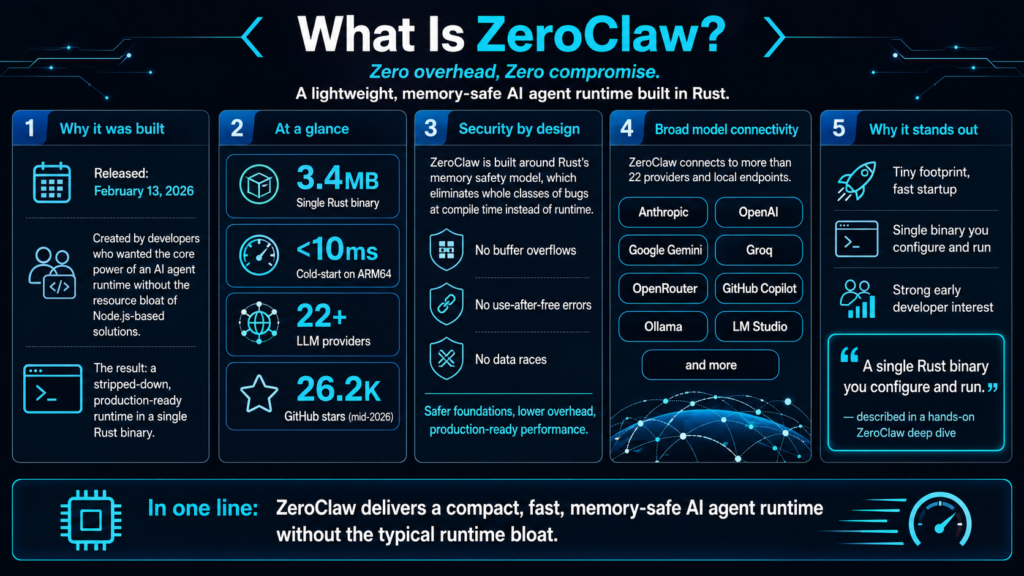
ZeroClaw dropped on February 13, 2026, with a tagline that doubles as a design philosophy: “Zero overhead, Zero compromise.” It was built by a group of developers who wanted all the core functionality of an AI agent runtime without the resource bloat of Node.js-based solutions. The result is a single Rust binary of just 3.4MB that can cold-start in under 10 milliseconds on ARM64 hardware.
ZeroClaw is built around Rust’s memory safety model, which eliminates entire categories of vulnerabilities like buffer overflows, use-after-free errors, and data races at compile time rather than at runtime. It connects to over 22 LLM providers including Anthropic, OpenAI, Google Gemini, Groq, OpenRouter, GitHub Copilot, and local endpoints like Ollama and LM Studio.
Despite its youth, ZeroClaw has already accumulated roughly 26,200 GitHub stars as of mid-2026, which is a strong signal of genuine developer interest. Dev.to’s hands-on ZeroClaw deep dive describes it as “a single Rust binary you configure and run,” which is about as stripped-down and elegant as agent runtimes get right now.
Architecture: Two Very Different Philosophies
This is the core of the entire comparison. OpenClaw and ZeroClaw are not just different implementations of the same idea; they represent fundamentally different philosophies about how an AI agent runtime should be built.
OpenClaw is built on Node.js with a TypeScript codebase and follows a traditional web-service architecture with separate processes handling the agent, API server, and various integrations. Its five modular components include a Gateway (WebSocket server for message routing), a Brain (reasoning and LLM orchestration), a Memory layer (persistent cross-session context), a Heartbeat scheduler (for proactive autonomous behavior), and a Skills layer (for plug-in capabilities).
ZeroClaw takes the opposite approach. Everything ships in a single binary. The WASM plugin system via Extism runs sandboxed plugins without external processes. A built-in hybrid SQLite memory system includes vector search and FTS5 keyword matching without any external database. The cron scheduler, tool system, and multi-agent delegation are all packaged into that same 3.4MB file.
In my experience reviewing frameworks like these, the architectural difference becomes most obvious when you try to run both on the same low-spec machine. OpenClaw brings Node.js and its entire dependency tree along for the ride, pushing baseline memory usage into the range of 390MB to 500MB+ just to keep the runtime alive. ZeroClaw idles at around 3.9MB of RAM. On a $5-10 per month VPS, that difference is not academic.
Head-to-Head Comparison Table
Performance: The Numbers Tell the Story
ZeroClaw’s performance benchmarks are genuinely remarkable for an agent runtime of this scope. The official benchmarks show cold starts under 10ms on ARM64 hardware and RAM usage idling below 5MB. By contrast, OpenClaw’s cold start sits anywhere from 2 to 15 seconds depending on active plugins, and its RAM footprint at idle pushes well past 390MB to 500MB+ just to keep the Node.js runtime alive.
For short-lived queries, ZeroClaw is clearly faster. Where it begins to show limits is at high concurrency. At 50 or more simultaneous sessions, OpenClaw scales better on multi-core hardware, handling 1,000+ requests per second in SaaS deployments. ZeroClaw peaks at around 200-500 req/s on edge hardware due to its single-threaded design, which makes it the wrong tool for high-volume enterprise workloads but an excellent choice for personal, edge, or embedded deployments.
This performance and resource breakdown from sparkco.ai captures the architectural divide well: for short-lived edge queries, ZeroClaw is faster, booting in under 0.5 seconds versus OpenClaw’s 2-5 seconds, but at high concurrency on multi-core hardware, OpenClaw scales significantly better.
Pro Tip: If you are running ZeroClaw and Ollama on the same low-spec VPS or single-board computer, ZeroClaw’s tiny footprint frees up nearly all of your available RAM for local model inference. Running OpenClaw alongside Ollama on the same $10 board is, realistically, not viable because the Node.js runtime alone eats most of your memory before inference even begins. ZeroClaw makes it work.
Security: This Is Where It Gets Serious
Security is arguably the most important differentiator between these two frameworks in 2026, and the gap is substantial.
ZeroClaw’s security advantage begins at the language level. Rust’s ownership model prevents entire vulnerability classes from ever compiling. The gateway binds to localhost only by default and requires a one-time pairing code for API access. Workspace paths are scoped, and a forbidden-path system prevents the agent from accessing sensitive directories without explicit permission. ZeroClaw consistently earns a Security Grade A in independent framework assessments.
OpenClaw’s security story is more complicated. The framework suffered a significant vulnerability in CVE-2026-25253, which compromised the AI gateway and enabled attackers to push commands at will. The ClawHub marketplace, which now hosts over 13,700+ raw skills in its unfiltered registry, has had 341 malicious skills identified by independent auditors. DigitalOcean’s 2026 skills security guide notes that 36% of all ClawHub skills contain detectable prompt injection, with 283 skills exposing credentials in plain text. That raw, permissive marketplace is precisely what gives OpenClaw its ecosystem breadth, and precisely what makes it a harder environment to secure.
To its credit, OpenClaw version 2026.2.26 introduced over 40 vulnerability patches, a VirusTotal partnership for daily skills scanning, and malicious skill auto-blocking. The project has moved meaningfully in the right direction. But if you are deploying in a regulated environment like finance or healthcare, ZeroClaw’s restrictive-by-default approach is the safer starting point.
Features and Ecosystem: OpenClaw’s Home Turf
OpenClaw’s biggest advantage is depth of ecosystem. With 13,700+ community skills on ClawHub, a Composio integration offering access to 1,000+ SaaS app connections, and native support for browser automation via Playwright, OpenClaw simply does more out of the box for most users. The Heartbeat scheduler, which wakes the agent every 15-30 minutes to proactively check emails, calendars, and dashboards, is a genuinely powerful feature that turns it from a chatbot into a true autonomous agent.
ZeroClaw counters with native features that OpenClaw typically handles through plugins. The built-in hybrid SQLite memory with vector search and FTS5 keyword matching works without any external database service. The WASM sandboxed plugin system via Extism gives developers a way to extend functionality without opening up a permissive marketplace of untested third-party code. Multi-agent delegation, the cron scheduler, and tool-calling APIs are all baked directly into the binary.
ZeroClaw is still catching up in terms of total integration coverage. OpenClaw’s Composio connectivity is hard to match right now. But ZeroClaw is releasing new provider and channel support rapidly, and the roadmap for Q1-Q2 2026 includes federated learning support and hardware acceleration, both of which will extend its edge deployment use cases significantly.
Step-by-Step: Which Framework Should You Choose?
Step 1: Assess your hardware.
If you are running on a $5-10 VPS, a Raspberry Pi, or any edge device under 512MB of RAM, ZeroClaw is the only realistic option. OpenClaw’s Node.js runtime alone requires 390MB to 500MB+ just to idle, which will exhaust your resources before the first LLM call completes.
Step 2: Evaluate your use case.
Are you building a personal always-on assistant connected to your messaging apps? OpenClaw’s messaging channel breadth and Heartbeat feature make it the more complete solution. Are you building agents for IoT, CI/CD pipelines, embedded systems, or video processing pipelines? ZeroClaw’s 10ms cold start and sub-5MB footprint are built for exactly that.
Step 3: Consider your security requirements.
For regulated industries, internal enterprise tools with sensitive data access, or any deployment where security is non-negotiable, ZeroClaw’s Rust-native safety model and restrictive defaults make it the more defensible choice. OpenClaw is safe when configured carefully, but it requires active hardening, especially given the volume of unvetted skills in its raw ClawHub registry.
Step 4: Think about community and long-term support.
OpenClaw has surged past 346,000 GitHub stars and has years of community knowledge, tutorials, and developer forum answers behind it, breaking historical open-source growth records in the process. ZeroClaw is new and growing fast at 26,200 stars in just a few months, but if you hit a niche problem, the OpenClaw community is simply larger.
Step 5: Decide on language preference.
If your team works primarily in Python, JavaScript, or Go, OpenClaw’s SDK support maps naturally to your existing stack. If you are a Rust developer or are building something where memory safety and performance are first-class concerns, ZeroClaw’s SDK is a much better fit.
2026 Trends: Where This Is All Heading
The broader AI agent framework landscape in 2026 is moving decisively toward Rust for performance-critical infrastructure. OSS Insight’s Q1 2026 analysis of GitHub’s fastest-growing AI agent repos found a clear pattern: the top-growing agent runtimes are built in Rust, not Python or TypeScript. ZeroClaw, IronClaw, and ZeroBoot all fit this trend. This does not mean Node.js frameworks like OpenClaw are dying, but it does mean the performance-first tier of the market is coalescing around Rust.
Edge AI deployment is the other defining trend. As inference costs on cloud infrastructure stay high and privacy regulations tighten, the ability to run a capable AI agent on a $10 board running on under 5MB of RAM is not just an engineering curiosity. It is becoming a genuine business requirement in industrial IoT, healthcare edge devices, and privacy-sensitive consumer applications.
ZeroClaw’s Q2 2026 roadmap includes hardware acceleration support, which, if delivered, could make it capable of running quantized local models on edge GPUs with minimal overhead. That would be a significant capability leap. OpenClaw’s 2026 roadmap, meanwhile, focuses on on-premise model hosting and tighter ClawHub security, both of which address known weaknesses.
For a practical walkthrough of how ZeroClaw performs in a real build, This hands-on video comparison of ZeroClaw and OpenClaw is worth checking out for a live look at the deployment difference.
Frequently Asked Questions
What is the main difference between ZeroClaw and OpenClaw?
The main difference is architecture and resource footprint. OpenClaw is a Node.js-based framework with a raw registry of 13,700+ community plugins on ClawHub and 346,000+ GitHub stars. ZeroClaw is a Rust-based, 3.4MB single binary that cold-starts in under 10ms and runs on under 5MB of RAM. OpenClaw prioritizes feature breadth, ZeroClaw prioritizes performance and security.
Is ZeroClaw more secure than OpenClaw?
In its default configuration, yes. ZeroClaw benefits from Rust’s compile-time memory safety, binds to localhost only by default, and has no permissive third-party plugin marketplace. OpenClaw has a more mature security hardening pathway, especially post-v2026.2.26, but its raw ClawHub registry of 13,700+ skills has documented issues with malicious entries and prompt injection vulnerabilities, including CVE-2026-25253.
Can ZeroClaw replace OpenClaw entirely?
For most individual developers and edge deployments, ZeroClaw covers the core use cases well. However, it currently lacks OpenClaw’s depth of messaging channel integrations, the Composio 1,000+ SaaS connector suite, and the vast ClawHub community skill library. For enterprise workloads requiring multi-tenancy, audit logs, and broad channel support, OpenClaw is still more complete.
What hardware can ZeroClaw run on?
ZeroClaw can run on essentially any hardware that supports a Rust binary. It has been demonstrated running on $10 single-board computers, ARM64 edge nodes, CI runners, and low-cost VPS instances. Its binary is 3.4MB and idles below 5MB of RAM, compared to OpenClaw’s 390MB to 500MB+ Node.js baseline.
Does ZeroClaw support local LLMs like Ollama?
Yes. ZeroClaw natively connects to Ollama and LM Studio endpoints in addition to cloud providers like Anthropic, OpenAI, Google Gemini, Groq, OpenRouter, and GitHub Copilot.
Which has better community support in 2026?
OpenClaw is significantly ahead on community support. It has surged past 346,000 GitHub stars, breaking open-source growth records, and has a large volume of Stack Overflow answers, tutorials, and years of community documentation. ZeroClaw is growing rapidly but is still a newer project.
Is OpenClaw free to use?
Yes, OpenClaw is licensed under MIT and is completely free for self-hosted deployments. SaaS-hosted versions may carry subscription costs depending on the provider.
Is ZeroClaw production-ready in 2026?
ZeroClaw launched in February 2026 and is on version 1.2 as of mid-2026. It is production-ready for edge and single-tenant deployments but lacks native multi-tenancy, enterprise audit logging, and some of the more advanced orchestration features that larger deployments might need. For personal or team-level deployments, it is stable and fast.
Can I run both OpenClaw and ZeroClaw simultaneously?
Technically yes, as they are independent processes, but there is rarely a reason to. You would typically choose one based on your deployment requirements. Some developers use ZeroClaw for lightweight edge agents and OpenClaw for their primary home server setup.
What programming languages do I need to know?
For OpenClaw, Python, JavaScript, or Go are the primary skill paths for customization. For ZeroClaw, Rust is the primary SDK language, though Python and JavaScript bindings exist. ZeroClaw’s configuration-first approach means many users can deploy it without writing Rust code at all.
Bottom Line
OpenClaw is the better choice if you want a mature, feature-complete autonomous AI agent with an extensive plugin ecosystem, broad messaging integrations, and a large support community that has pushed the project past 346,000 GitHub stars. ZeroClaw is the better choice if you are deploying on constrained hardware, working in security-sensitive environments, or building edge AI applications where a 3.4MB binary that starts in 10ms is a hard requirement. Both are impressive projects. In my opinion, ZeroClaw represents where agent infrastructure is heading in 2026, even if OpenClaw still leads on breadth and community scale today.