Yes, OpenClaw can make you real money in 2026, but not in the way most people think. The tool itself is free and open-source. Your income comes from the services, products, and systems you build on top of it. The people earning $5,000 to $20,000 per month are not “using OpenClaw to make money.” They are selling automation, content, software, and consulting powered by OpenClaw under the hood. That distinction matters more than any list of side hustles.
What Is OpenClaw, and Why Is Everyone Talking About It?
OpenClaw is a free, open-source AI agent framework that runs locally on your machine and connects large language models to real software, apps, and workflows. Created by Peter Steinberger, it has exploded to over 331,000 GitHub stars as of early 2026, making it arguably the fastest-growing open-source project in AI history.
Unlike ChatGPT or Claude, which respond to prompts in a chat window, OpenClaw actually does things. It can browse the web, write and execute code, manage files, send messages across WhatsApp, Telegram, Discord, Slack, and iMessage, scrape data, generate reports, and chain complex multi-step tasks together without you touching the keyboard.
The March 2026 release introduced ClawHub, an official plugin marketplace similar to VS Code’s extension ecosystem. With 5,700+ skills already available and growing rapidly, ClawHub has opened a brand new monetization layer that did not exist even six months ago. Premium skills sell for $10 to $200 each, enterprise custom builds go for $500 to $2,000, and the early sellers are already reporting consistent passive income.
What makes OpenClaw genuinely different from every other AI tool hyped in recent years is that it runs 24/7 without supervision, deploys in a single click, and requires no coding to get started with basic workflows. That combination of accessibility and raw automation power is exactly why it has unlocked so many real income opportunities in 2026.
Pro Tip: Before you try to “make money with OpenClaw,” spend one week simply using it to automate something in your own life or work. Once you feel the productivity shift firsthand, monetizing it for others becomes obvious. The best business ideas come from solving your own problems first.
Does OpenClaw Actually Make Money, or Is It Just Hype?
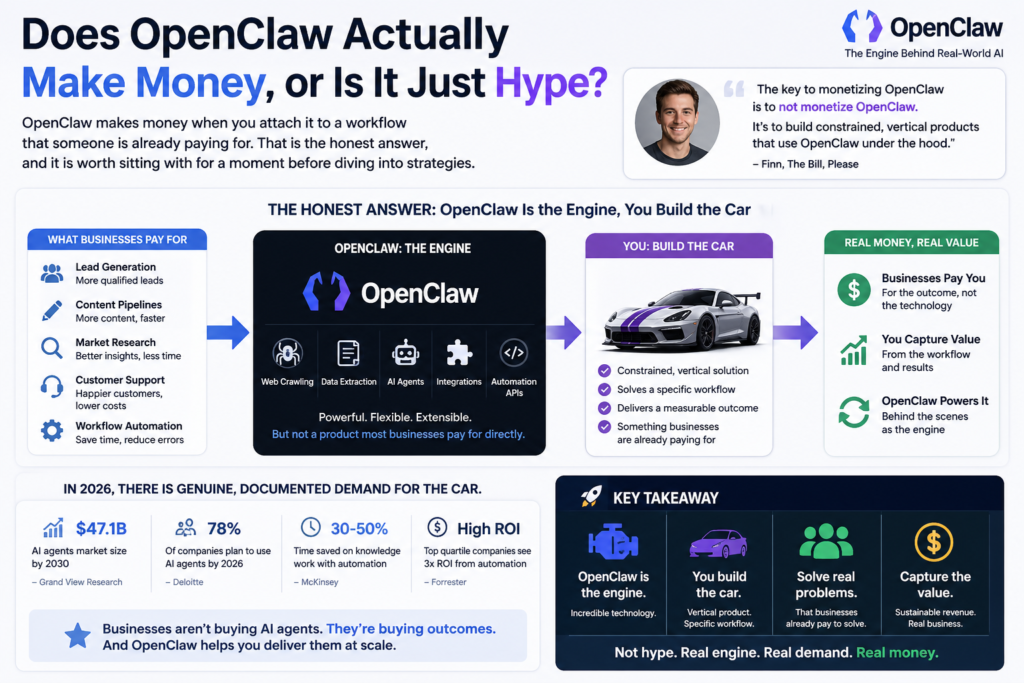
OpenClaw makes money when you attach it to a workflow that someone is already paying for. That is the honest answer, and it is worth sitting with for a moment before diving into strategies.
Finn’s analysis on The Bill, Please puts it clearly: “The key to monetizing OpenClaw is to not monetize OpenClaw. It’s to build constrained, vertical products that use OpenClaw under the hood.” That framing is exactly right. Businesses do not pay for AI agents as a concept. They pay for lead generation, content pipelines, market research, customer support, and workflow automation because those things save time and generate revenue.
OpenClaw is the engine. You are building the car. And in 2026, there is genuine, documented demand for the car.
The Top 10 Ways to Make Money With OpenClaw
1. Freelance Automation Services
This is the highest-demand and fastest-to-start income stream available right now. Small and medium-sized businesses are drowning in repetitive tasks that do not justify a full-time hire. An OpenClaw agent can handle email triage, lead follow-up, competitor monitoring, report generation, and social media scheduling automatically. The business owner gets the results without the overhead.
As a freelancer, you can package this in three layers. First, charge a one-time setup fee between $250 and $600 to install, configure, and train the client on their custom agent. Second, offer an ongoing monthly retainer from $300 to $800 for prompt refinement, performance monitoring, and adding new capabilities over time. Third, build out a full automation system for larger clients at $1,500 to $3,000 per project. Once you have a working configuration for one client in a specific industry, you can adapt and resell a nearly identical setup to the next client in that same niche in a fraction of the time.
In my experience, the biggest mistake freelancers make is going too broad. Position yourself as the OpenClaw automation specialist for one vertical, whether that is real estate, e-commerce, law firms, or local service businesses, and you will close deals much faster than someone pitching “AI automation for everyone.”
2. AI Content and SEO Agency
Content marketing is one of the most scalable OpenClaw income streams because the same agent configuration produces output for dozens of clients simultaneously. An OpenClaw agent can be configured to research keywords, analyze competitor articles, generate SEO-optimized blog drafts, write product descriptions, create social media captions, and schedule posts across platforms, all based on a brief and a brand voice guide.
The business model here is straightforward. You charge $300 to $800 per month for 8 to 12 pieces of content per client, including keyword research, AI-assisted drafting, and scheduled publishing. Shopify store owners, local service businesses, and SaaS startups are the best buyers. Social media management packages run $200 to $500 per month for consistent post drafting and calendar management.
The economics of this model are excellent because your cost scales in API usage, which is typically $3 to $50 per month for most OpenClaw workflows, while your revenue scales in clients. Ten content clients at $500 per month is $5,000 per month with a very thin cost structure.
3. Lead Generation Services
Lead generation is one of the clearest fits for OpenClaw’s capabilities. An agent can scrape business directories, enrich contact information, filter by industry and location, verify emails, and deliver a clean, organized prospect list to a client every morning via email or Slack.
A standard lead generation workflow with OpenClaw looks like this: the agent collects contacts from selected platforms, organizes the data in a spreadsheet, generates a summary report, and sends it to the client automatically. Freelancers typically charge $500 to $1,500 per month for this as a managed service. You set it up once, monitor it weekly, and collect recurring revenue as long as the client is happy with the results.
Local businesses, sales agencies, and B2B software companies are hungry for consistent, qualified leads. If you can deliver 200 to 500 verified contacts per week in a specific niche, you will have no trouble finding clients willing to pay monthly for that output.
4. Data Scraping and Market Intelligence
Data is one of the most valuable commodities in 2026, and OpenClaw is extremely well-suited to collecting, organizing, and reporting on it at scale. Agents can monitor competitor pricing, track product listings across marketplaces, gather job postings, follow social media mentions, and compile industry trend reports from public sources.
Retail and e-commerce businesses frequently want daily summaries of competitor pricing changes. A well-configured OpenClaw agent can scrape multiple websites, store the results, highlight changes, and deliver a formatted report every morning. Market intelligence services like this typically sell for $300 to $2,000 for one-time scraping projects and carry monthly fees of $500 to $1,500 for continuous monitoring.
Because OpenClaw can schedule and chain tasks automatically, these systems operate without daily intervention. You build and configure the workflow, test it, hand it off to the client, and collect a monthly retainer.
5. Selling Premium Skills on ClawHub
ClawHub is OpenClaw’s official plugin marketplace, introduced in the March 2026 release, and it has quickly become one of the most interesting passive income opportunities in the ecosystem. Developers build “skills,” which are structured configuration files and workflows that extend what OpenClaw agents can do, and list them on ClawHub for $10 to $200 each.
Early skill sellers focused on high-value, niche workflows are already reporting $100 to $1,000 per month in passive income from a single well-targeted skill. Examples include Shopify inventory management agents, real estate follow-up workflows, podcast production pipelines, and customer support triage systems. Enterprise custom skill builds are going for $500 to $2,000 per project.
The most compelling part of the ClawHub model is that unlike SaaS, there is no infrastructure to maintain after the initial build. You build the skill once, list it, and earn from ongoing downloads as the OpenClaw user base grows. Given that the project just crossed 331,000 GitHub stars and is still accelerating, the addressable market for well-built skills is expanding every week.
6. Micro-SaaS Products Powered by OpenClaw
This is the highest ceiling income stream on this list, and also the most technically demanding. The model involves packaging an OpenClaw agent plus a front-end interface, payment system, and user dashboard into a complete software product for a narrow audience, then charging a monthly subscription fee.
SuperFrameworks’ breakdown of OpenClaw business ideas identifies several strong examples: an AI agent that monitors competitor pricing and sends daily digests, a social media content generator for specific industries, a customer support ticket triage tool, and a review monitor for Shopify stores. Specialized dashboards selling at $29 to $99 per month per customer can be built and launched in two to four weeks if you already have a development background.
The economics here are exceptional. At $49 per month with 200 paying customers, you are generating $9,800 per month in recurring revenue. Your OpenClaw API costs remain low, and the product runs itself. Micro-SaaS takes the longest to reach its first dollar, but it produces the most durable and scalable income of any strategy on this list.
7. AI Consulting and Strategy
As OpenClaw adoption accelerates in 2026, there is growing demand from mid-sized businesses that understand they need AI automation but have no idea where to start. AI consulting fills that gap. You are not selling a tool or a service. You are selling expertise, strategy, and clarity.
A typical engagement involves auditing a business’s current workflows, identifying the highest-impact automation opportunities, building a roadmap, and either handing off the implementation or delivering it yourself. Consulting day rates in this space typically run $500 to $1,500 per day for solo consultants with a demonstrable track record.
The key to making consulting work as a business is productizing your offer. Instead of custom scoping every project, create two or three fixed-price packages. An “Automation Audit” at $500, a “90-Day AI Integration” at $3,000, and an “Ongoing Advisory Retainer” at $1,000 per month are a solid starting framework. You will close more clients and spend less time in proposal cycles.
8. OpenClaw Courses and Tutorials
OpenClaw crossed one million users faster than almost any previous developer tool, and the demand for structured learning content has significantly outpaced the available supply. If you have solid hands-on experience with OpenClaw, there is a real market for courses, video tutorials, written guides, and community workshops.
Course creators in the OpenClaw space are earning $500 to $5,000 per month depending on platform, format, and audience size. YouTube tutorials with strong SEO draw consistent organic traffic and generate ad revenue plus affiliate income. Paid courses on platforms like Gumroad, Teachable, or Lemon Squeezy are selling well for niche, outcome-focused topics like “Setting Up OpenClaw for Shopify Stores” or “Building a Lead Generation Agent in 60 Minutes.”
This comprehensive breakdown of 12 ways to make money with OpenClaw gives a solid overview of the income landscape and is a good reference for understanding how creators are packaging their knowledge in 2026.
9. Configuration Template Packs
Template packs sit between full courses and skills on ClawHub in terms of complexity and price. These are pre-built OpenClaw configuration files, prompts, and workflow setups packaged together and sold as a downloadable product. A buyer installs the pack, customizes a few variables for their specific use case, and has a working automation system in under an hour.
Template packs sell well at $30 to $150 per pack on Gumroad, Lemon Squeezy, or directly via a simple landing page. Niche-specific bundles, such as a Real Estate Agent Pack, an E-Commerce Seller Pack, or a Content Creator Automation Bundle, convert better than generic offerings. Creators with an existing audience or a good SEO presence on their website are reporting $200 to $2,000 per month from template pack sales with very little ongoing effort after the initial build.
10. Affiliate Revenue from the OpenClaw Ecosystem
As OpenClaw’s ecosystem has grown, so has the number of adjacent services built around it: API providers, hosting platforms, memory tools, integration services, and premium support tiers. Many of these services run affiliate programs with generous commissions.
Hostinger’s guide to making money with OpenClaw notes that affiliate revenue from API providers and hosting referrals is a viable passive income layer generating $300 to $3,000 per month for creators with consistent content output. The strategy works best when paired with an existing content presence, whether that is a YouTube channel, a blog, or a newsletter. You create genuinely useful tutorials and guides, link to the tools your audience needs, and earn a commission each time someone signs up through your link.
The affiliate angle is not a standalone business, but as a secondary income layer bolted onto content creation or consulting, it adds meaningful, low-effort revenue over time.
Income Potential Comparison Table
Step-by-Step: How to Start Making Money With OpenClaw

Step 1: Install and Explore OpenClaw Locally
Download OpenClaw and run it on your machine. Spend at least a week using it for real tasks, whether that is organizing your inbox, generating content, or scraping competitor data for your own projects. You cannot sell what you have not used.
Step 2: Pick One Income Stream Based on Your Current Skills
If you are a developer, start with ClawHub skills or micro-SaaS. If you are a marketer, start with an AI content agency. If you are a generalist, freelance automation services are the fastest path to your first dollar. Do not try to do all ten at once.
Step 3: Build and Test Your First Offer
Create a working OpenClaw workflow that solves a specific problem for a specific type of client. Test it thoroughly. Document what it does, how it does it, and what results it produces. Your documentation becomes your sales pitch.
Step 4: Find Your First Three Clients or Customers
Your first three clients will not come from ads. They will come from direct outreach, LinkedIn, Reddit communities, freelance platforms like Upwork and Fiverr, and your existing network. Offer a reduced rate or a free pilot in exchange for a case study and testimonial.
Step 5: Systematize Before You Scale
Once you have proven the workflow works and clients are happy, systematize every part of the delivery process. Document the setup steps, create templates, build onboarding checklists. Only once the system runs predictably should you try to scale to more clients or build a second income stream.
Step 6: Add a Passive Layer
After your active income stream is stable, add one passive layer. If you are doing automation services, build a template pack from your best configurations. If you are consulting, create a course from your most common advice. This is how you move from trading time for money to building a real business.
2026 Trends Shaping OpenClaw Monetization
The OpenClaw ecosystem in 2026 is moving fast, and a few trends are worth paying attention to if you want to stay ahead.
Multi-agent workflows are becoming standard. Rather than a single agent handling a task end to end, sophisticated setups in 2026 involve multiple specialized agents passing work to each other, with one agent researching, another writing, and a third publishing and reporting. Freelancers and consultants who understand how to architect these pipelines are commanding significantly higher rates than those offering single-agent setups.
B2B vertical products are where the serious money is accumulating. As one analysis in The Bill, Please noted, the businesses most willing to pay hundreds to thousands per month for an AI agent are B2B companies with clearly defined, repeatable workflows. Healthcare, legal, real estate, e-commerce, and logistics are the verticals seeing the most adoption and the highest willingness to pay.
The ClawHub marketplace is still early. With 5,700+ skills currently listed, the marketplace is large enough to validate demand but still early enough that well-built, niche-specific skills face surprisingly little direct competition. The window for being a meaningful early mover in this space will not stay open forever.
Frequently Asked Questions
Can a complete beginner make money with OpenClaw?
Yes, though it depends on which income stream you pursue. Freelance automation services, content agencies, and lead generation services do not require coding and can generate income within weeks. More technical approaches like micro-SaaS and ClawHub skill development require a higher skill baseline. Beginners should start with service-based models and work their way toward passive income streams over time.
How much does it cost to run OpenClaw?
OpenClaw itself is completely free and open-source. Your main operating cost is the API usage for whichever LLM you connect it to. For most freelance or small agency setups, this runs between $3 and $50 per month. Larger, high-volume production workflows can cost more, but even then the margins remain strong relative to the revenue the automations generate.
Is OpenClaw legal to use for commercial purposes?
Yes. OpenClaw is licensed under the MIT license, which explicitly permits commercial use. You are free to build paid products and services using OpenClaw without licensing fees or restrictions from the core project. Always check the terms of any third-party APIs or data sources your agent interacts with, as those may have their own commercial use policies.
How long does it take to set up a profitable OpenClaw business?
For service-based models like freelance automation or content agencies, most people are generating their first paid clients within two to four weeks. For passive income models like ClawHub skills or micro-SaaS, a realistic timeline to first revenue is four to eight weeks. Scaling to $5,000 per month or more typically takes three to six months of consistent effort.
What is ClawHub and how do I sell on it?
ClawHub is OpenClaw’s official plugin and skills marketplace, launched in March 2026. It allows developers to publish skills, which are structured configuration files and workflow packages that extend OpenClaw’s capabilities. To sell on ClawHub, you build a skill that solves a specific, high-value problem, package it according to the marketplace’s submission guidelines, and list it at a price between $10 and $200. ClawHub takes a marketplace fee on paid transactions similar to app store economics.
Do I need to know how to code to make money with OpenClaw?
Not necessarily. Several income streams, including freelance automation services, content agencies, lead generation, consulting, and affiliate marketing, require little to no coding. If you want to build micro-SaaS products or sell premium skills on ClawHub, a basic technical background helps significantly. That said, OpenClaw’s no-code setup and growing library of pre-built skills mean that non-developers can accomplish a great deal without ever writing a line of code.
What are the most profitable OpenClaw niches in 2026?
Based on current market activity, the most profitable niches are B2B lead generation, e-commerce automation for Shopify stores, real estate follow-up and lead management, SEO content pipelines for local service businesses, and customer support automation for SaaS companies. These verticals have businesses with clear workflows, established willingness to pay for automation, and a high volume of potential clients.
Bottom Line
OpenClaw is real, the demand is real, and the income opportunities are real. But they belong to people who treat it as infrastructure for a service or product, not as a magic income button. Pick one income stream that fits your current skills, build something that works, find your first three clients, and scale from there. The ecosystem is still early enough that consistent execution beats any amount of clever positioning.